Let’s Talk About Word of Mouth, the Unforeseen, and Delicious Trouble
Okay friends, I think it needs to be stated that none of the photos on my wee blog are AI, none of the words are either. When I quote something, I’m usually typing it out while eyeballing it in a paper book. And I’ve usually underlined it and dogeared the page it’s on. So that’s where we’re at. It’s fine. We’re making it happen amiright?
Firstly, dig Heraclitus:
“Whoever cannot seek
the unforeseen sees nothing,
for the known way
is an impasse.”
We are not moving into a knowable future, but you know what, we never were.
I have to say that the research I’m doing on the novel I’m writing about libraries and card catalogues and the future, is so much fun and taking me to the coolest places. In the old days, I’d probably share some of that here, but it’s the new upside down secretive world of writing that we now inhabit I suppose and it seems folly to speak about one’s projects. But one essay that pops out is by Umberto Eco, on censorship. He wrote it in 2009 and it feels like he knew what our times would be like, because it was a lesser version of the noise filled world then. This is when the world began filling with digital noise, “an excess of information.” He says, “This great need for noise is like a drug: it is a way to avoid focusing on what is really important….” He refers to Saint Augustine and “Redi in interiorem hominem,” return to the interior (hu)man.
The thing I find most interesting is that he also says that even when people are oppressed by “the most censorious tyrants” they have been “able to find out all that is going on in the world through popular word of mouth.” And this is why he says that the biggest “ethical problems we face today is how to return to silence.” He calls for a study of semiotics of reticence, a semiotics of silence in political debate, in theater, and in other forms of communication. He asks us to consider the long pause, “silence as creation of suspense, silence as threat, silence as agreement, silence as denial, silence in music.”
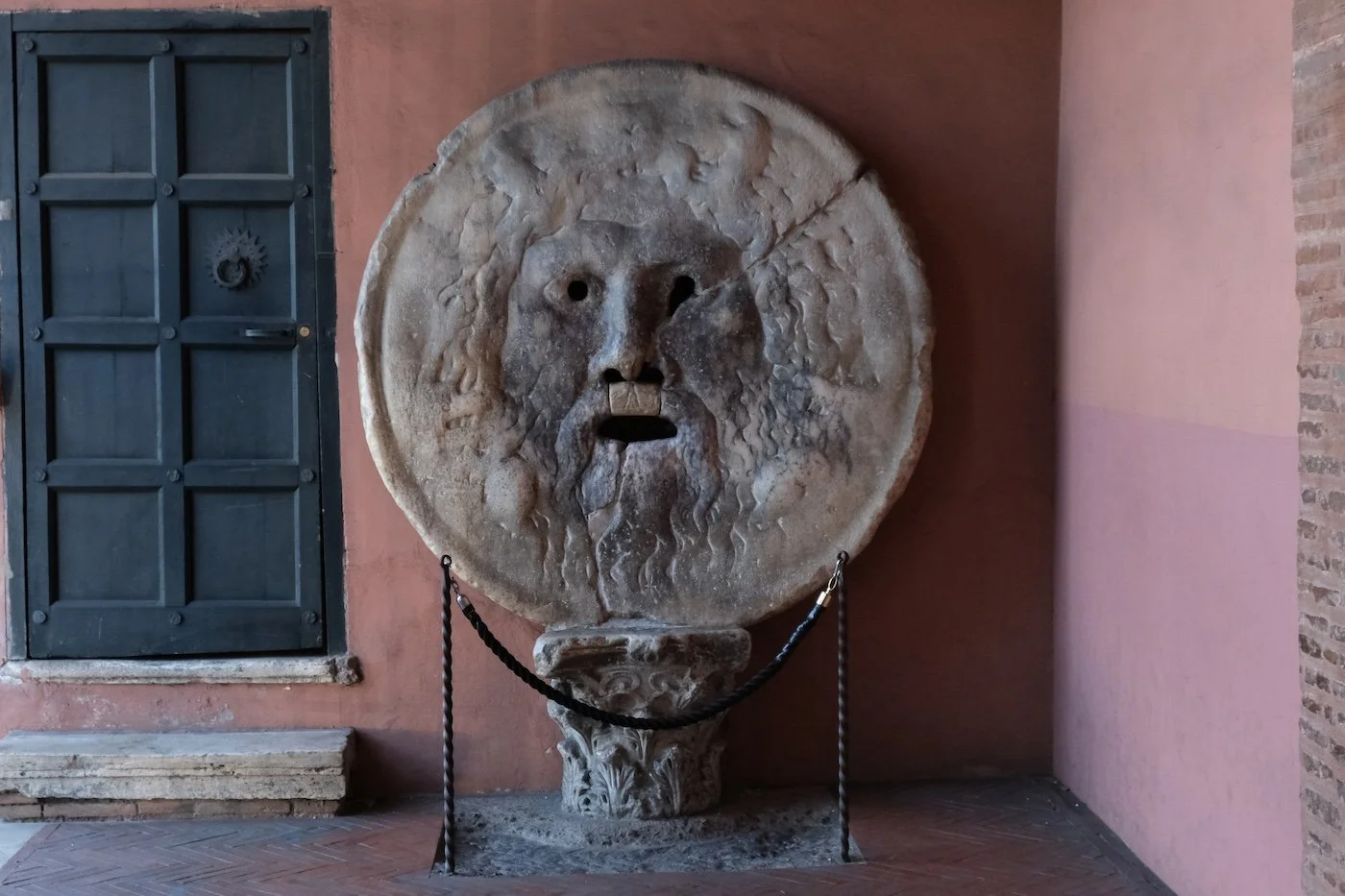
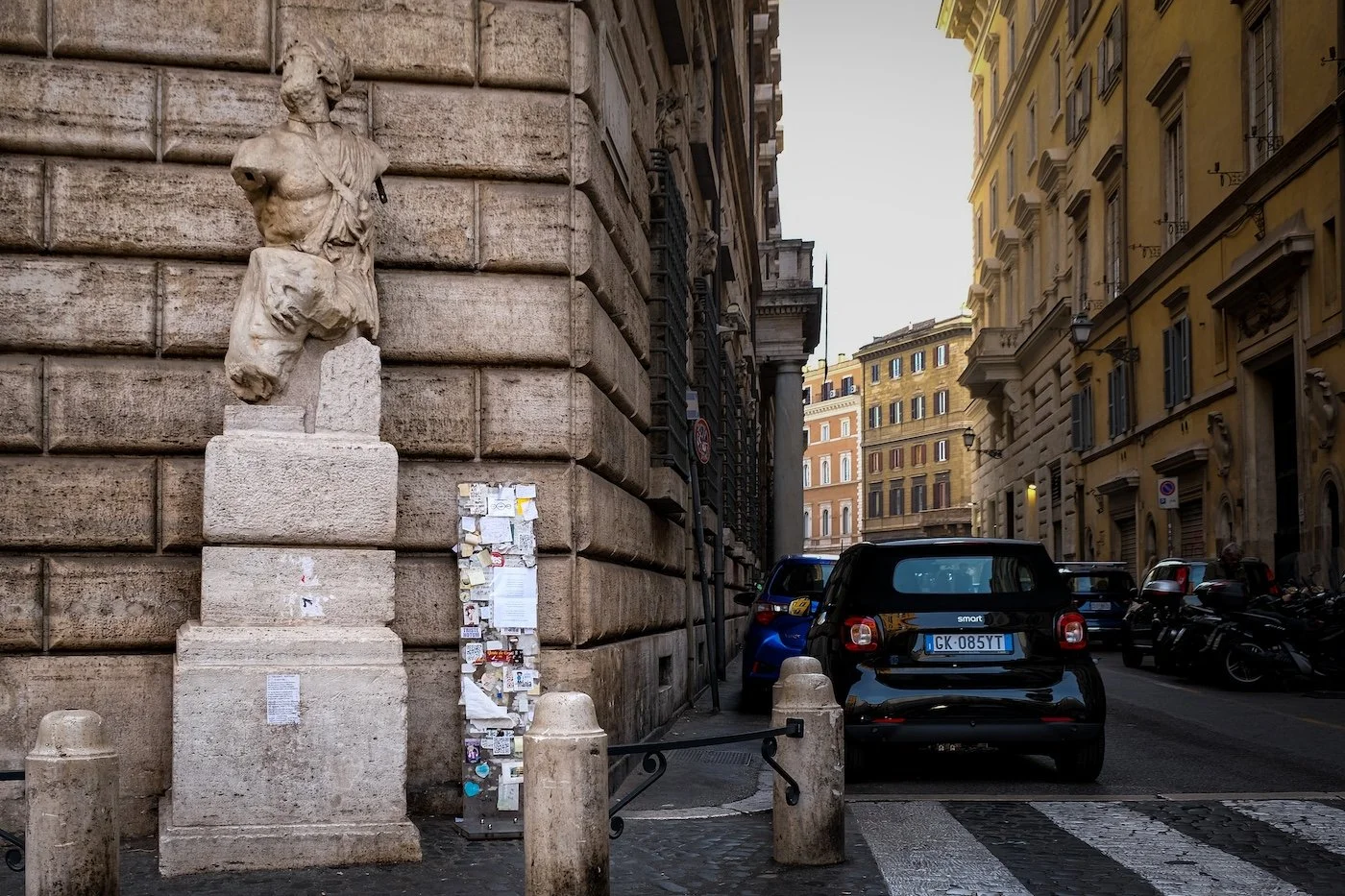
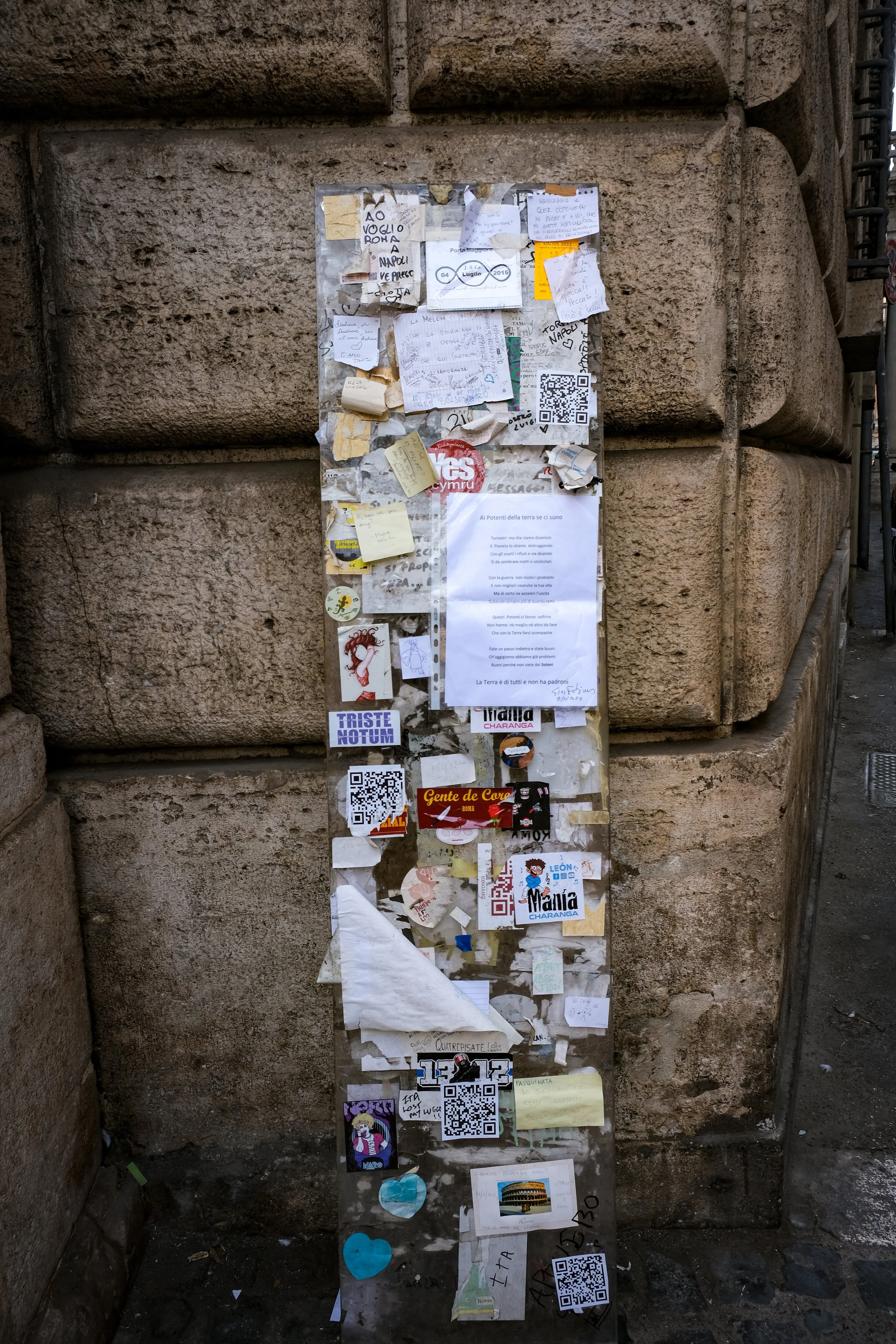
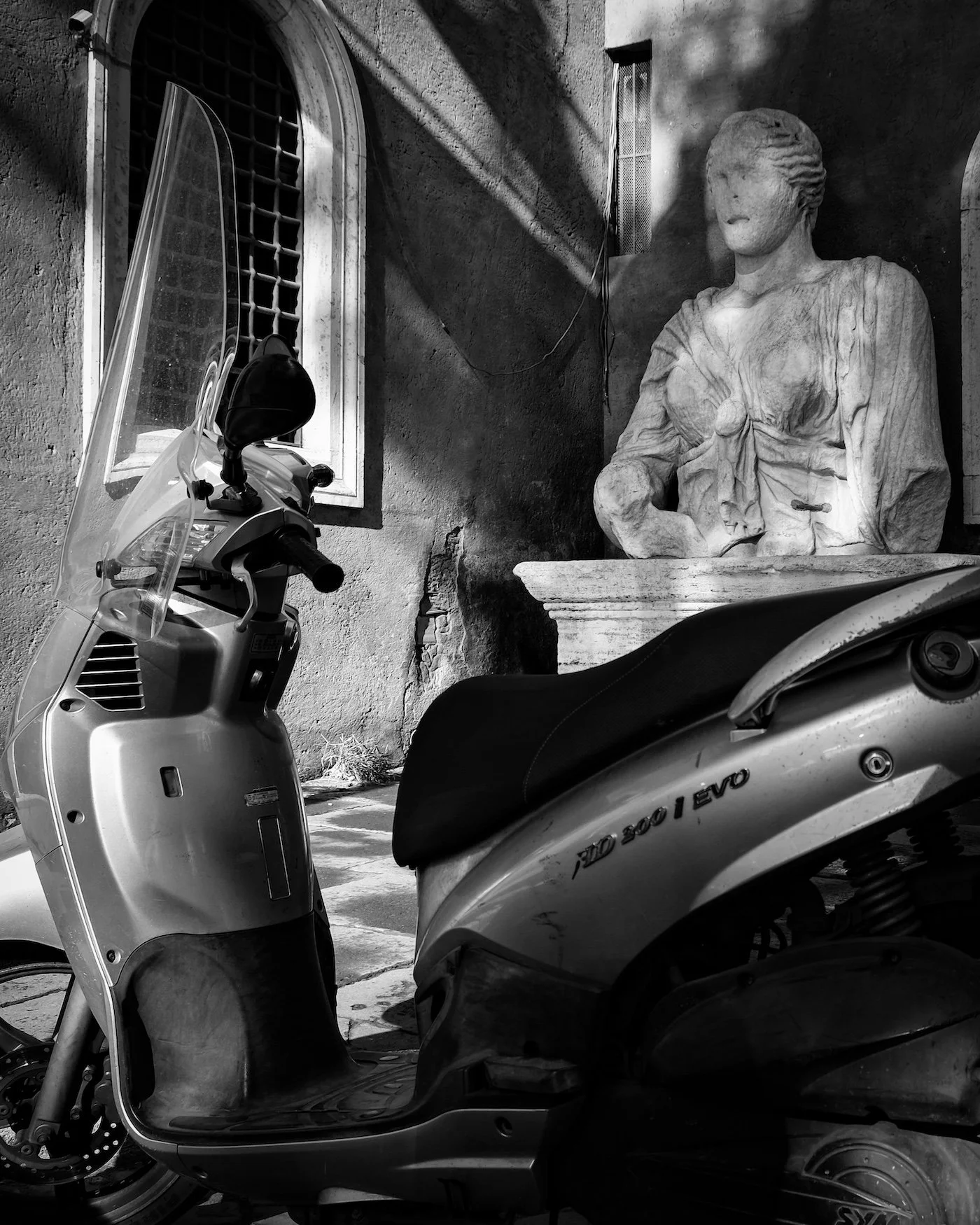
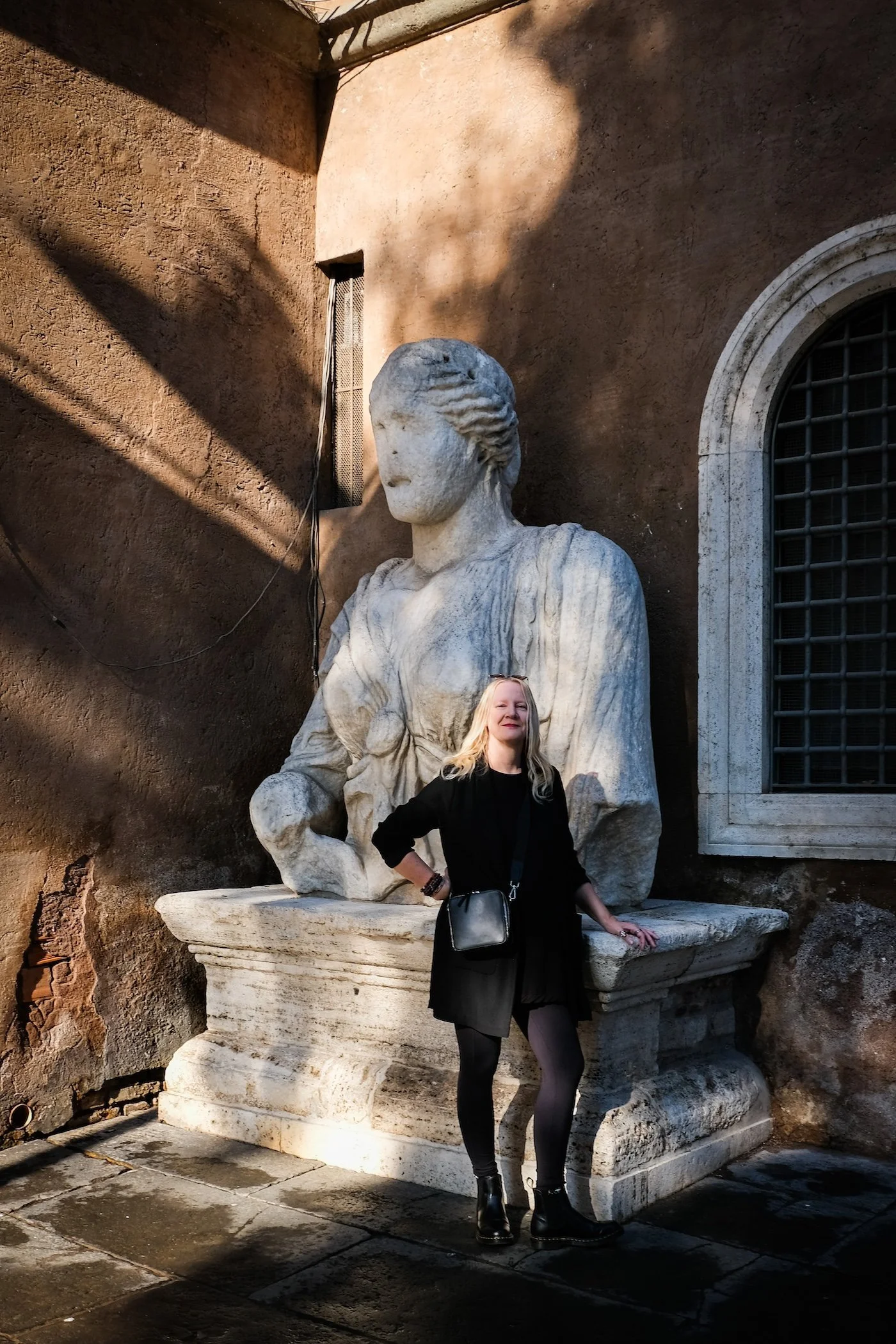
Thinking about word of mouth, I went back and looked at my photos from our trip to Rome where we made it a side quest to look for all of the talking statues. I had been obsessed with Elliott Erwitt’s book Rome with his photo of Madama Lucrezia on the cover. So I kept returning hoping to create a modern version, or to play on that photo anyway.
Perhaps what is needed is a return of the talking statue. But what is the contemporary version of that? Maybe the answer is already there. And then, word of mouth. How to encourage that? At Latitude 53 it’s hard to get out and chat with the neighbours during our long dark winters, but summer is here and the time is right. Who can you chat up about what? The latest great book you’ve read, the latest protest, creative ways to resist?
Probably one of my desert island books is going to be Beauty by the late, gorgeous human, John O’Donohue. I picked it up for the first time in a while, and it just gets better you know? In it he quotes Plotinus who says that Beauty will ever induce “wonderment and a delicious trouble, longing and love and a trembling that is all delight.”
And aren’t we all also longing for some delicious trouble about now?
Another thing O’Donohue talks about is reverence as a path to beauty. Reverence is an art, which in our world, he says, we seem to have lost. He says, it cannot be “reduced to a social posture.” “Reverence bestows dignity and it is only in the light of dignity that the beauty and mystery of a person will become visible.” He also says that “reverence is respect before mystery.”
I mean, this is the kind of language I want to hear, to converse in, be in conversation with. I’m so tired of the dullards and dunces dumbing down the magnificence of this mysterious and joy-filled world. I want grace-moments, I want beauty, I want mystery, depth and spirit. John O’Donohue says that “what you encounter, recognize or discover depends to a large degree on the quality of your approach” and he talks about “rituals of approach.” We need to have reverence for the sacred zones of one another. So.
We are in an imagination battle, as adrienne marie brown has said in her book on emergence. We need to invent new ways to see, to write, to be. Or maybe it’s a reclaiming of the old ways. I’ve been embracing my film camera, I always write with a fountain pen. I’m going to be on social media a bit less, I swear lol, or at least be there more on my own terms. I’m planning a reset time, turning it off for a week or so here and there. Maybe even a month at some point in the near future.
O’Donohue talks about the imagination. It is like a lantern, “it illuminates the inner landscapes of our life and helps us discover their secret archaeologies.” How to see the mystery and beauty ever-present?
We can cultivate the “grace of innocence” and tap into our “passion for freedom.” Our hearts are wild, naturally. We can still answer the call to a creative life for we know instinctively what that is. The imaginative life is one of mystery, ecstasy, joy, possibility, delight, revelation, and with some perseverance, perhaps transcendence.
Times are always changing; let us use this time, we creative souls, spirits, to reinvent what creativity is even. Let’s find new ways to share our work, new ways to create, perhaps more secretly or word of mouth. Let’s share with those who approach with reverence. The others never wanted our offerings anyway.
A poem by the Polish poet, Julia Hartwig from the wonderful book, In Praise of the Unfinished has been hitting me:
Higher and Higher
Born on a trash heap, victims of seven plagues, we
proclaim every day a victory.
One more day. I am still alive.
While the trash heap grows and lifts us up, toward
immortality.
Lastly, like everyone else in the known universe, I’ve been watching the truly graceful behaviour, the dignified, and beautifully delightful behaviour of Stephen Colbert in the wind up to his brilliant show. And like so many others I am delighted by his talk of the joy machine which is what he calls the collective endeavour of everyone who worked on the show.
I want a joy revolution. I really do. I want to work at the joy machine. But of course, that job is always open for anyone who applies.
(Hélène Cixous: “We who are bits of sun, drops of ocean, atoms of the god, and who so often forget this, or are unaware of it, and so we take ourselves for employees. We who forget we could also be as luminous, as light, as the swallow that crosses the summit of the incomparable hill Fuji, so intensely radiant that we could ourselves be the painter’s models…..”).
We are bits of sun, but the conditions are not always present. But what if we could remember that we are not employees at all? We are drops of sunlight in the service of the joy machine, the beauty machine…
And maybe I’ve had it wrong. Maybe: The conditions are always there. The conditions: You are alive.
And wouldn’t that just be some delicious rebellious trouble? If we were all to start creating our own joy machines, right where we are? In our homes, workplaces, everywhere. And then all those joy machines come together at some point into a beautiful poem. I mean, it could happen. I can envision all those joy machines in some kind of Miyazaki world.
To conclude:
The answer to a lot of our questions continues to be variations of: beauty, love, joy.