The Axe, My Writing Into the Desk Era, and Other Bouquets
— This past week reading Franz Wright’s Axe in Blossom, his last poems and fragments. A fragment: “I hear the axe is in bloom once more.”
Which will remind you of Kafka:
“I think we ought to read only the kind of books that wound or stab us. If the book we’re reading doesn’t wake us up with a blow to the head, what are we reading for? So that it will make us happy, as you write? Good Lord, we would be happy precisely if we had no books, and the kind of books that make us happy are the kind we could write ourselves if we had to. But we need books that affect us like a disaster, that grieve us deeply, like the death of someone we loved more than ourselves, like being banished into forests far from everyone, like a suicide. A book must be the axe for the frozen sea within us. That is my belief.”
— Franz Wright, Franz Kafka. Makes sense, yes?
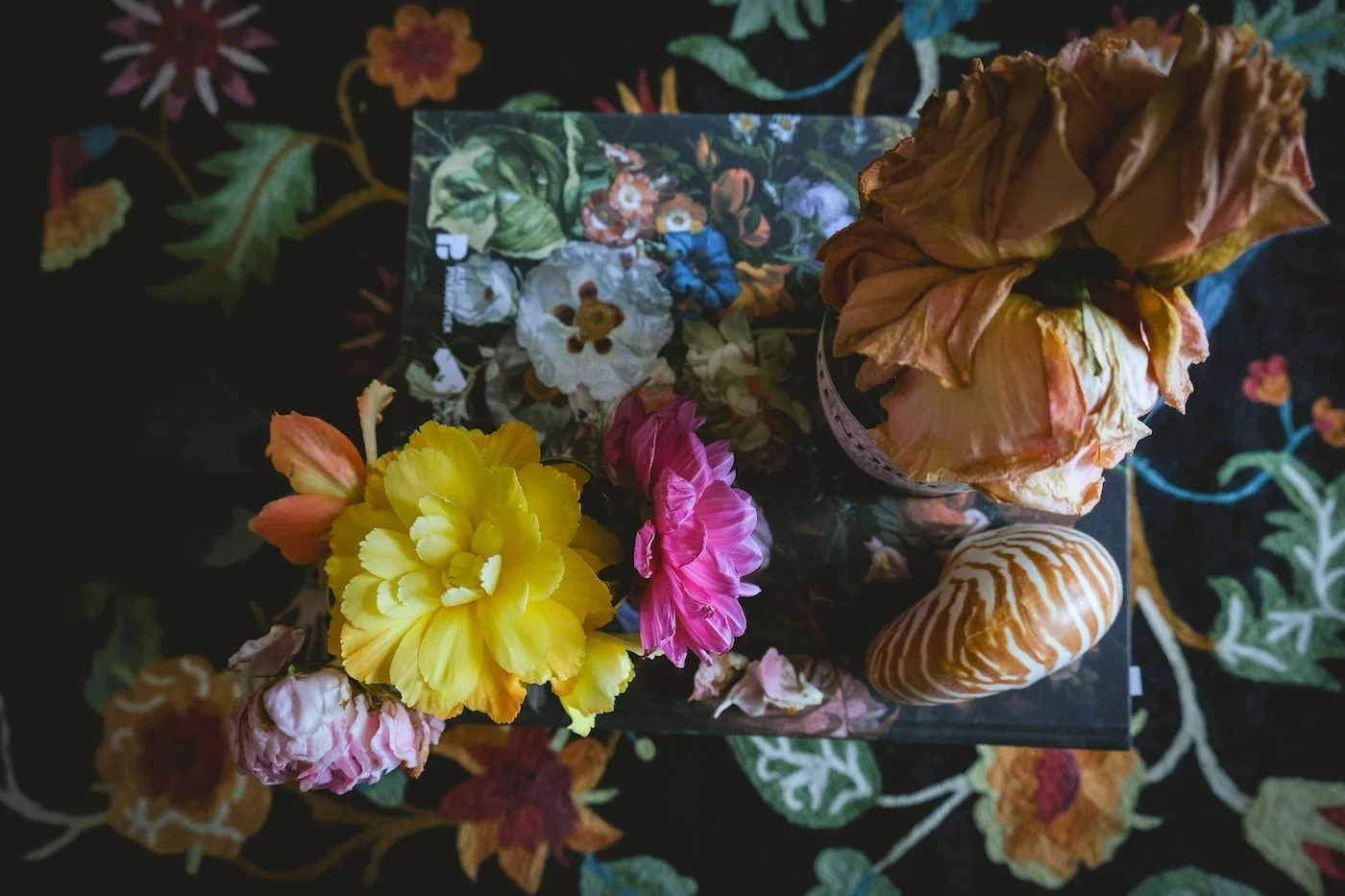
— Well, the publisher talks about Franz Wright’s themes in the Axe in Blossom, noting, “his belief in the poem’s ability to rhyme with the mysteries of our worldly suffering.” The axe in bloom recurs in the book, as we might hold up a bouquet of flowers and turn it this way and that, seeing how it looks in the morning light and the afternoon light, the golden light, civil twilight, nautical twilight.

— Remind me some day to tell you about the time a guy took an axe, full-sized, out of his gym bag and then stared so hard at me there were flames, reminding me of that time I’d gotten him kicked out of the space.
— All the Wrights, that destiny. If you read TwB regularly-ish you’ll likely know of my fondness for the work of C.D. Wright, and Charles Wright. Charles is 90 and the last one standing, though I’m sure there are other Wrights out there writing. I hope so. Charles Wright is there in my backyard whenever I’m out there with my journal, a pen. I owe so much to Charles Wright for his presence there, the way he makes the birds sing, and my soul calm, and the way I can look at things well, after a period of angst or worry.
— Back to axes, though. Have you read the essay by John Berger in his classic book On Looking, titled “Seker Ahmet and the Forest”? He talks about the painting by the artist Seker Ahmet Paşa, Woodcutter in the Forest. Berger says, “As soon as I looked at it, it began to interest and haunt me.” And, “Its precision is existential. It accords with the experience of forest.” Berger brings us to Heidegger. Berger says that the “task of philosophy is to find the Weg, the woodcutter’s path through the forest.” He says, “the path may lead to the Lichtung, the clearing whose very space, open to light and vision, is the most surprising thing about existence, and is the very condition of Being.” And the axe? It’s somewhere in the painting even if we can’t quite see it.
— Have you heard Simon Sinek’s story about the axe? I think I’ve quoted from it before. And yes the commenter on le YouTube who says, “banal” is not wrong lol, but also…sometimes people need to hear things told surprisingly and simply. Sometimes I do!
— I picked up Derek Beaulieu’s book from the library: Do It Wrong: How to Be a Poet in the Twenty-First Century. And it’s for poets, but anyone creating art will find it useful. As most of my readers here are non-Canadians, Derek Beaulieu is sort of our version of Austin Kleon, for context. He’s weirder, edgier, and probably wears a tuque more often, than his American counterpart. He tells Canadian artists to stop comparing ourselves to American ones. “Cut the fantasies and the bullshit: the grass isn’t greener elsewhere. The only way forward is through cultural action, working together, and creating artwork that imagines and advocates for a bigger, weirder future, no matter what side of the border you find yourself on.”
— “Imagine a book,” says Beaulieu, “you don’t know you want to read. Write to discover that book, to expand your idea of what is possible and what you can imagine yourself writing”
— He also reminded me of this from Virginia Woolf: “What has praise and fame to do with poetry? Was not writing poetry a secret transaction, a voice answering a voice?”
— Which then reminded me of my favourite line from Phyllis Webb, “The proper response to a poem is another poem.” This is not in the Beaulieu book (unless I missed it) but could be. Perhaps his next. Anyway, such a good book for new writers and old crotchety ones such as meself.
— I’m not sure I even agree with all of it, you know. But while Austin Kleon is all “Steal like an artist” Beaulieu is “steal my work” and “give it away.”
— I have the world’s best colleagues, and one of them was telling me about the Russian expression to “write into the desk” or “write into the drawer.” I guess “desk” is more of a literal translation, and I prefer that translation, but drawer is more common. This was done when the regime forced writers to conform and so the alternative was to write freely though silently, to write for the drawer, to go unpublished.
— And in a way, Beaulieu takes this idea of writing freely, without an eye to publication, but then says, find a way to share. He values the prioritization of conversation and collaboration. He prioritizes fun. So, that’s cool. At the same time, he also believes artists should get paid. Helltotheyes.
— One can check to see if one’s work has been scraped for AI and by now I’m sure every author has whether it shows up here or not. (Or will be one way or another). The image below shows which books of mine have been pillaged without permission or recompense, that we know of.
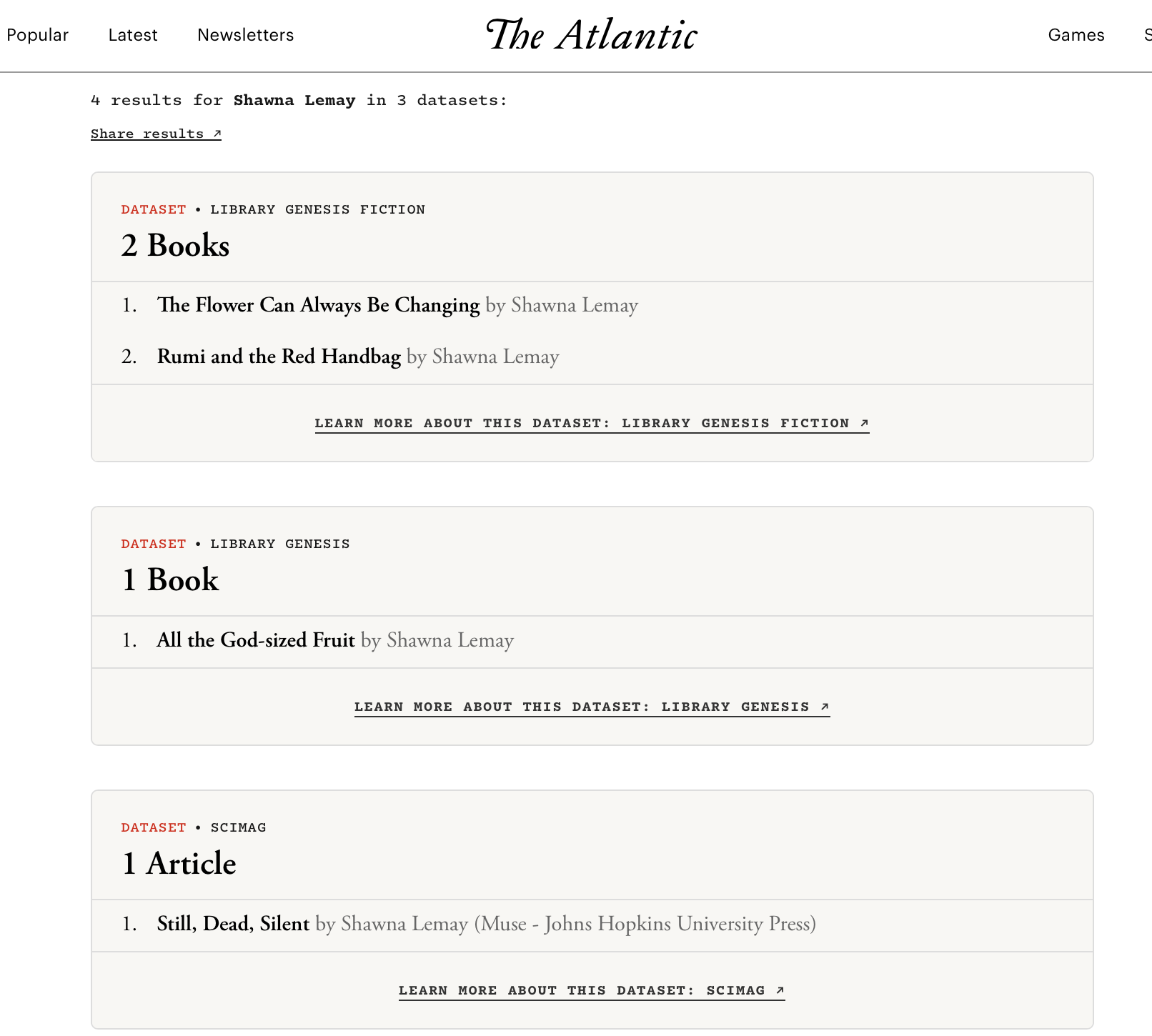
— How does this make you feel? a therapist, if I could afford a therapist which I cannot, might ask. Shitty. Very shitty. Dirty? Used? Gross. So I guess my hatred for degenerative AI is a bit personal hey.
— Anyway, while it will never happen, how’s this for a motto: Steal Like a Librarian. ie, with footnotes, bibliography, proper citation, giving credit where credit is due, payment where applicable.
— And yes to sharing. Always. But ask permission? I’ve told my Charles Simic story before, I think? In my book Everything Affects Everyone (reviewed here), I really wanted to include his poem, In the Library. After going back and forth with my publisher a few times about what and how the poem would be used and why and who the heck I was, he wrote this simple and generous response:
“Use it. You have my permission and please send me the book,
Best,
Simic”
— I cannot tell you how much I cherish that no nonsense generosity.
— For those not in the know, Charles Simic is a revered poet, Pulitzer Prize winner etc. He died a couple of years after my book came out, but he had asked for a copy. I yes do sometimes wonder if he read it or at least flipped through to see his poem. I’m going to imagine he did.
— I guess I’m drawn to writers by the name of Charles, and those with the last name Wright.
— While I’m still in my Prima Donna Rat Hermit Era, I’m also sort of in a Writing Into My Desk Era. I mean, I am all for sharing, but there’s a time for that. It will come. Currently, I’m really stuffing a lot of my creativity into a secret desk and man it feels good.
— To end with, a link to a search on this site about flower poems. In the lead up to my 10 year anniversary of writing this blog, I’m going to be more intentional in bringing older posts into the light so to speak.
— And, though it isn’t something I love doing, pointing out that you could support the work I do here by hitting the Ko-fi button. I’m challenging folks to give one dollar if you’ve enjoyed reading these posts this previous year, or the last 10 years. And thank you to those who pitched in last week! A real shot in the arm xoxoxoxo
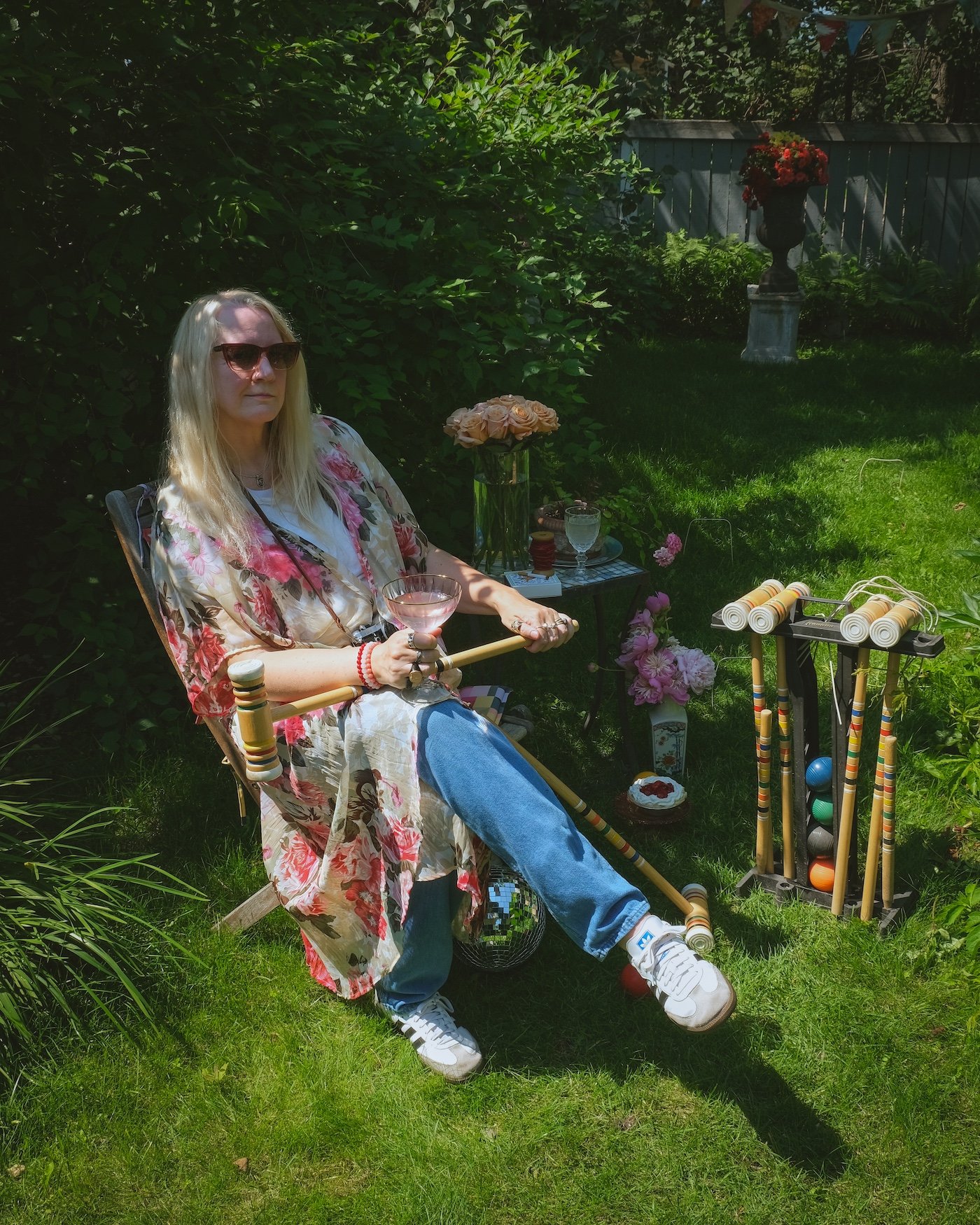
— Note on the photos: taken with my FujiFilm Xt4 by me and with an assist by Rob. Words by me unless otherwise noted.