Daily Life with the Comedic Wisdom of Jane Austen – Essay
The 250th Anniversary of Jane Austen’s birth is December 16, 2025. A perfect day to read one of her books and perhaps indulge in a re-watch of your favourite adaptation. Many will be hosting dinners and teas and even balls that day!
This past July, I was delighted to participate in a series titled, Unexpectedly Austen. You’ve possible read a previous post where I shared a couple of essays I wrote about Austen-related topics:
In 2018 I wrote a piece titled, “The Sponge-Cake Model of Friendship,” which was published on All Lit Up. And somehow food ends up being another jumping off point in an essay I wrote for Sarah Emsley’s guest series, “A Summer Party for Sense and Sensibility.” My contribution is titled “Of Sandwiches and Obligations.”
Below is a sort of essay, sort of ramble, in honour of Jane Austen and the way her comedic genius has made my everyday life so much better.
When Blaise Pascal instructed that in difficult times you should always carry something beautiful in your mind, he wouldn’t have had Jane Austen’s works to commit to memory. And maybe when you hear that suggestion, your thoughts might more immediately turn to poetry, or songs, maybe a favourite painting, a cherished landscape that you can call up from your childhood.
I’m not the sort who has a great memory for reciting poetry by heart, or lines of Shakespeare, or passages from novels. But as a longtime fan of Austen, thanks to repeated readings, lines from her novels will appear in my head unbidden on occasion and lord that is a beautiful thing. I know I’m not alone in this. Usually it’s just an internal recitation, and an outward smile, but occasionally I’ll say a line out loud and if it’s recognized, well, you know you have a new friend. Thankfully my husband has also read all the books and watched the movies, so he knows what I’m on about, if no one else does.
Going out in the winter, we’ll be driving our car in the snow and cold and wind and one of us will invariably reference Mr. Woodhouse. We’ll be all, “A man…must have a very good opinion of himself when he asks people to leave their own fireside, and encounter such a day as this, for the sake of coming to see him. He must think himself a most agreeable fellow; I could not do such a thing. It is the greatest absurdity — Actually snowing at this moment!” (Volume 1, Chapter 13).
And then there is that multi-use line said by Mary Bennet in Chapter 39 of Pride and Prejudice: “I should infinitely prefer a book.” Of course if you know Mary Bennet, you know.
““I should infinitely prefer a book.””
After heavy holiday eating I’ll have a bowl of cereal for dinner, and call it after Mr. Woodhouse, “a small basin of thin gruel.” And I mean, seriously, a little cream of wheat on a winter night can hit the spot or if you’re Canadian you might prefer Sunny Boy cereal, which is what I grew up eating.
Someone says something nonsensical to me, and it’s Mr. Bennet: “I have not the pleasure of understanding you.” And you know, some days you’re Mrs. Bennet: “You take delight in vexing me. You have no compassion of my poor nerves.” And other days you’re Mr. Bennet: “You mistake me, my dear. I have a high respect for your nerves. They are my old friends. I have heard you mention them with consideration these twenty years at least.” And back to Mrs. Bennet: “Ah! You do not know what I suffer!”
““Ah! You do not know what I suffer!” ”
We love how Mr. Darcy goes from “She is tolerable, but not handsome enough to tempt me” to noticing Elizabeth’s fine eyes every 5 minutes. Ahh, Mr. Darcy, such a serious foil. “My good opinion once lost, is lost for ever.” And how many times have I said that in my head these last many years? But even Mr. Darcy ends that conversation with a smile. I’ve often had to remind myself that like Elizabeth, “I dearly love a laugh.” When I’ve not been smiling enough, not hanging out with those who make me laugh, I know I’m not in the right place. Like Austen, Elizabeth doesn’t ridicule. She says, “I hope I never ridicule what is wise or good.” Let the ridiculous be ridiculous, and I for one will happily laugh at them. The good shall only be gently mocked.
““My good opinion once lost, is lost for ever.””
We’ll come back to Pride and Prejudice, that goldmine, but Henry Tilney often comes to mind when someone shows off a new fit. Suddenly, I perfectly understand muslins, and “I do not think it will wash well” pops into my head, no matter the fabric. And after I feel I’ve been a bore or said something silly in a conversation, I always trot out, “I shall make but a poor figure in your journal to-morrow.”
““I shall make but a poor figure in your journal to-morrow.””
Whenever I walk to my car after work in the dark past 9pm down Jasper Avenue, I hear Jane Fairfax from Emma in my head when she is setting out to walk to Highbury alone, “Yes — what should hurt me? — I walk fast. I shall be home in twenty minutes.” Emma presses her, and she replies, “Thank you, thank you — but on no account. — I would rather walk. — And for me to be afraid of walking alone!”
Emma notices that she is fatigued, and Jane Fairfax: “I am — she answered — ‘I am fatigued; but it is not the sort of fatigue — quick walking will refresh me. — Miss Woodhouse, we all know at times what it is to be wearied in spirits. Mine, I confess, are exhausted. The greatest kindness you can show me, will be to let me have my own way…”
““...we all know at times what it is to be wearied in spirits. Mine, I confess, are exhausted.””
I cannot tell you how often the words from the adaptation of Emma pops into my head: “Badly done, Emma!” (The text from the novel reads: “Her situation should secure your compassion. It was badly done, indeed”!) Sometimes I’ll be referring to myself, because hey, am I perfect? But the phrase will have many uses out there in this world of ours. “It was badly done, indeed!”
When I’m feeling for someone as Emma did Harriet after her relationship with Mr. Knightley is secured, I can feel “with pain and with contrition” but also, “no flight of generosity run mad.”
When I’m grappling with a falsehood, “Seldom, very seldom, does complete truth belong to any human disclosure; seldom can it happen that something is not a little disguised, or a little mistaken.” (From Emma).
Persuasion, if I had to choose, is my favourite Austen novel. Anne recommending a course of reading to Captain Benwick is bibliotherapy at its best. He is “intimately acquainted with all the tenderest songs of one poet, and all the impassioned descriptions of hopeless agony of the other.” Of poetry, his was the temperament which suggested he “ought to taste it but sparingly.” He writes down her recommendations, seems to take her advice to heart. Anne, self-aware wise soul that she is, realizes “she had been eloquent on a point in which her own conduct would ill bear examination.” And isn’t this often the way?
And while Anne Elliot is a decided favourite of mine, I also adore Mrs. Croft. Her line, “We none of us expect to be in smooth water all our days” is such a good reminder. (Because actually smooth water is alluring…). Let us not expect it, we do not expect it, and of course these days, truly, none of us do expect it.
““We none of us expect to be in smooth water all our days.” ”
When it is remarked upon what a great traveller she must have been by Mrs. Musgrove, Mrs. Croft replies, “Pretty well, ma’am, in the fifteen years of my marriage; though many women have done more. I have crossed the Atlantic four times, and have been once to the East Indies, and back again…” etc. I always think about Mrs. Croft when I say I have been somewhere and then the other party goes on at length telling me about being in this same place for 3 days as though it were something I’d never heard of when in fact I had over the years collectively been there for 5 months. No matter.
Well, we could likely continue this fine game for some time, but one can’t help but mention Elizabeth’s admonishment to Mr. Darcy, “had you behaved in a more gentlemanlike manner…”
And then there is of course the spongecake quotation from my essay, and the line from her juvenilia which I use very often, “Run mad as often as you chuse; but do not faint.”
““Run mad as often as you chuse; but do not faint.” ”
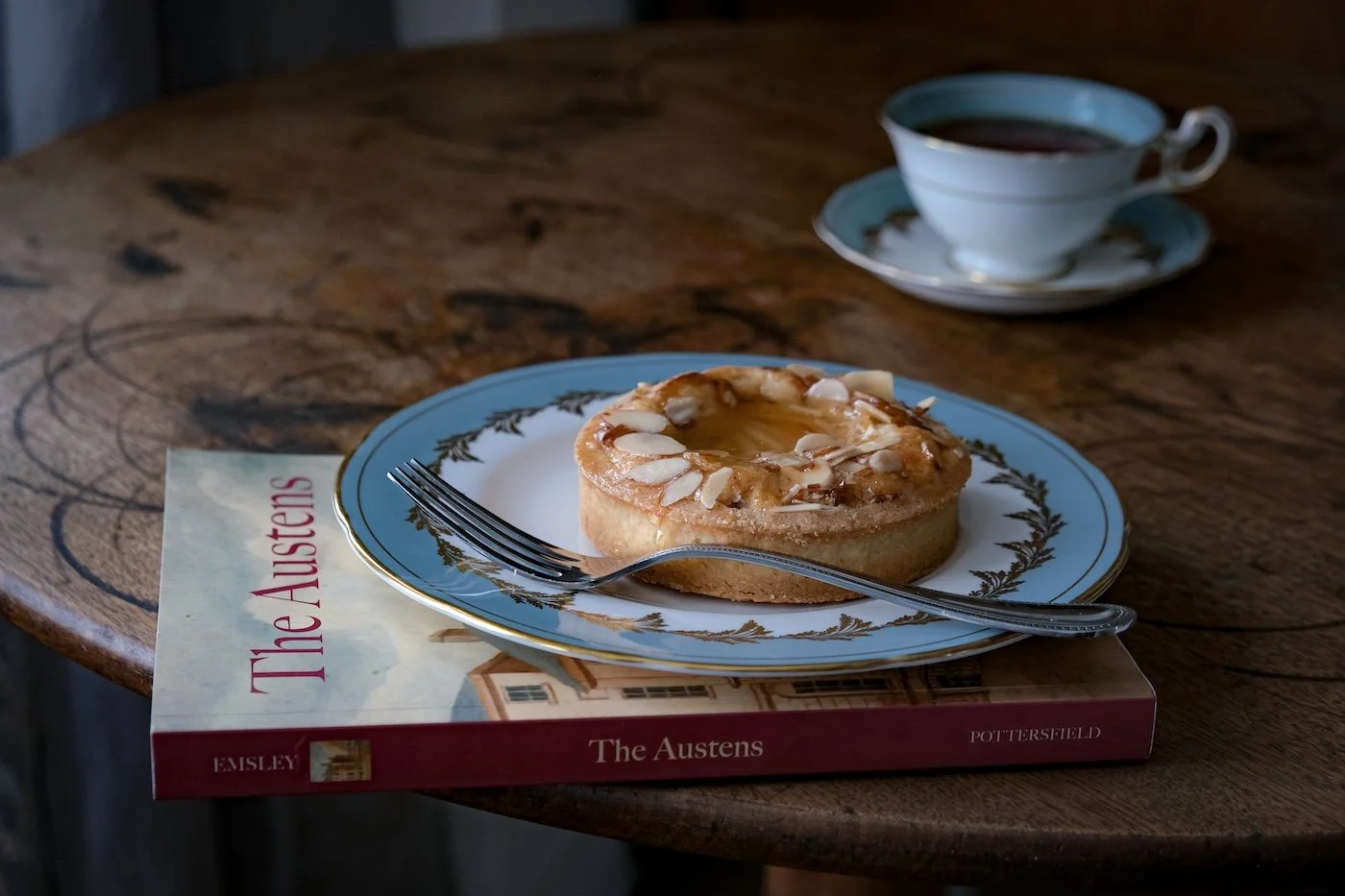
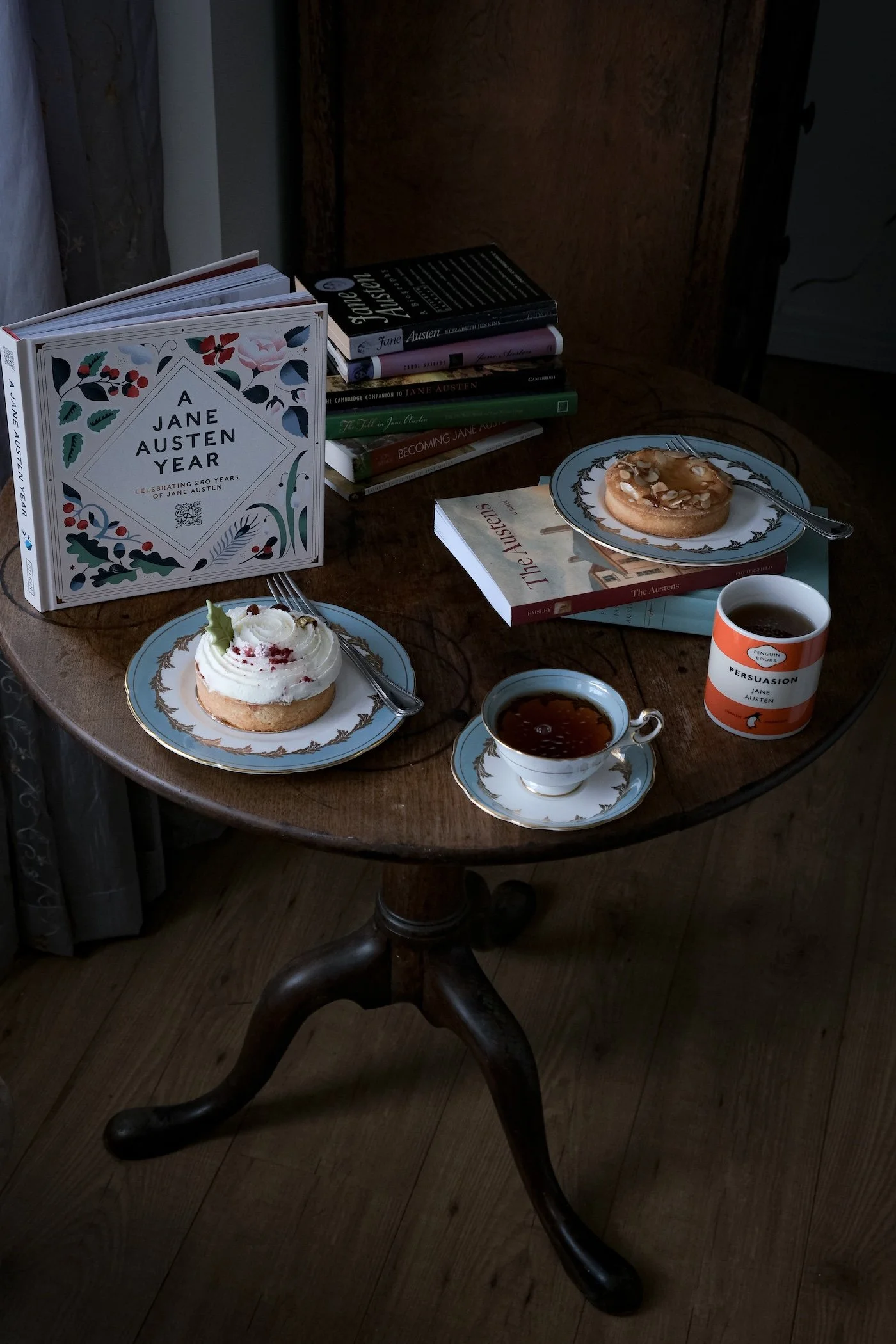
Online celebrations for the 250th anniversary have been going on all year, to my delight, and these next few days promise to be equally delightful. I shall enjoy watching the fun from the safety of my own hermitage and sitting at home with an Austen book or related book or two. (Might I recommend Sarah Emsley’s The Austens (pictured above) if you’ve not yet read it?)
Let me know if you’ll be celebrating! Would love to hear how you’ll mark the occasion. And let me know what lines from Austen pop into your head unbidden! :)
My own guy celebrates his birthday on the 14th and with Jane Austen’s birthday on the 16th we are definitely going to be honouring Sagittarius season here.
My next post will be (gods willing) on January first of next year! Hope to see you back here then! Warmly,