Transcendence and Excellence: A New Year 2026
This is the year I’m stepping off of the battlefield and this is the year I’m tending to the horizon. No more justifying the need for beauty, for transcendence. Let those opposed live in their own ruins. I hearby declare this: The Year of the Courageous Creative.
“You cannot do this to them, these are my people;
I am not speaking of poetry, I am not speaking of art.
you cannot do this to them, these are my people.
you cannot hack away the horizon in front of their eyes.”
— Gwendolyn MacEwen
I’ve ranted about AI in many places but in the end I’ve decided to leave it alone (I mean, after this one last rant). Because you cannot hack away our horizon. Excellence will speak to excellence. The Merriam Webster word of the year for 2025 is Slop. And it really is time to mock the atrocious AI rubbish that is infiltrating pretty much everything. Let them cure cancer if they can — we’re all waiting. But also, to step away from that conversation — we’ll never convince the AI lovers that the creative existence is so much more, exacts so much more, rewards more richly than they can imagine. There are better conversations to be had. (For me, I’m just quietly unfollowing anyone or any organization that insults me with slop generated images. But there are other approaches to show distaste, such as the recent successful and wonderful Icelandair video, and the backlash about the MacDonald’s AI video). Also, let’s continue to replace the word intelligence with automation and just remember the ethical paucity behind the plagiarism machine (feel free to enter my name). Also, let’s use words like integrity, ethics, human(e) more.
The meaning of life, I’ve come to believe with my whole heart, resides in transcendence but the conditions for this possibility aren’t always there.
But okay, onward.
As Adam Zagajewski said in his poem “Self-Portrait, Not Without Doubts”
“hey, friends, courage
life is beautiful,
the world is rich and full of history.”
Hey, friends, courage, they cannot hack away our horizon.
And hey, friends, “In some sense the world is always in the position of this unfinished manuscript, even if we don’t see any masterpiece in progress at the moment.” This is also Adam Zagajewski from his collection of essays, Another Beauty. In the same piece he writes about how poetry holds “a spark of an ancient, magical vision of the world, which must also be the vision of the future, that is, if we want the world not simply to survive but to retain some semblance of spiritual health.” And I’m quite fine with glorifying our spiritual health.
Hey, friends, they cannot hack away our spiritual health.
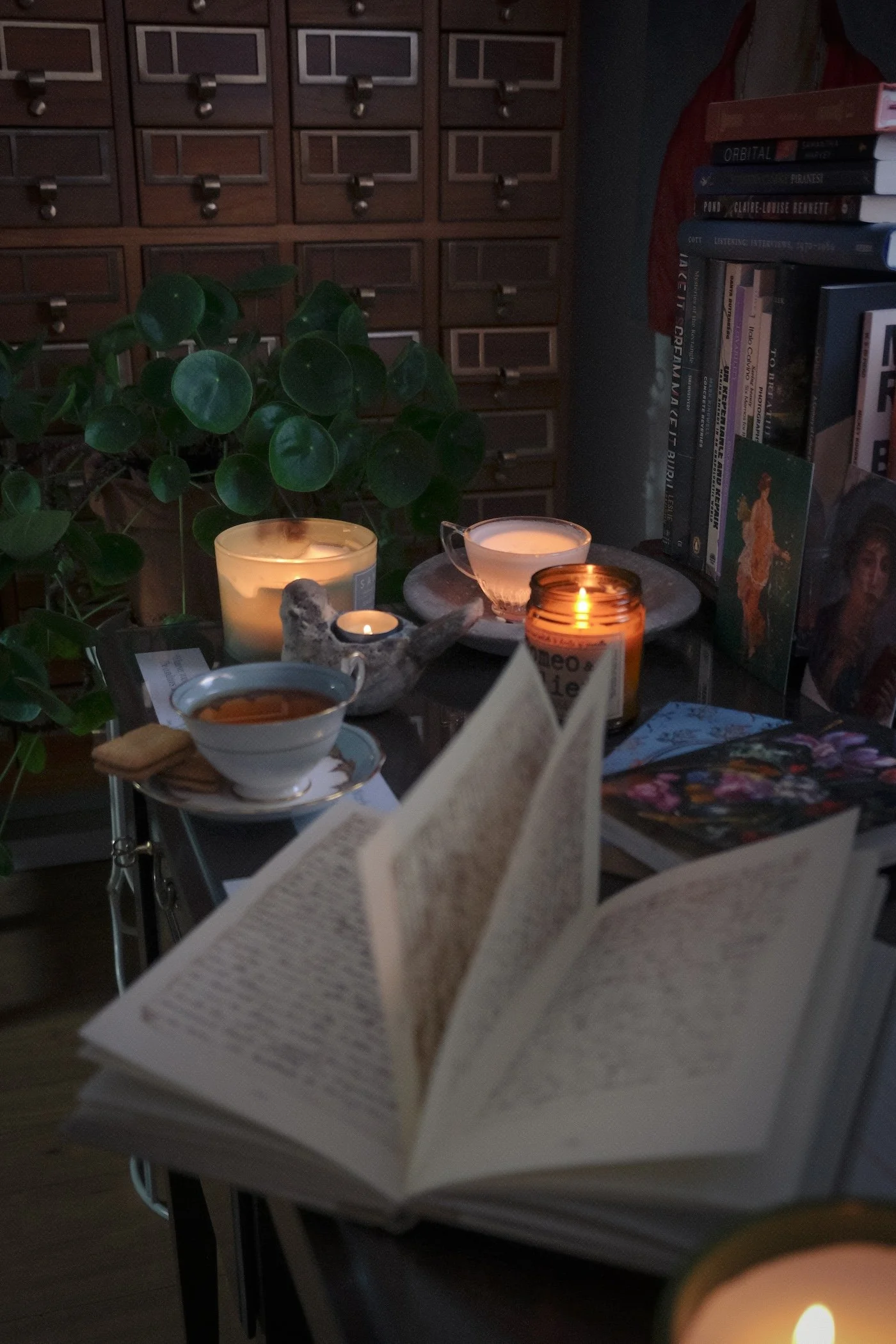
Write things down with a pen in a notebook. It will centre you. Keep re-wiring your brain. Read books. Scroll less. I came across the term, “bloom scrolling” from Lucy at Tolstoy Therapy. Remember that the future is not yet settled. And rejoice in the fact that analog has made a huge resurgence, and that indie booksellers are having a renaissance. It’s easy to doom scroll but I’m going to be working on both bloom scrolling and also just scrolling less in 2026.

“Follow the lights in your own skull,” says C.D. Wright in Cooling Time, a must-read.
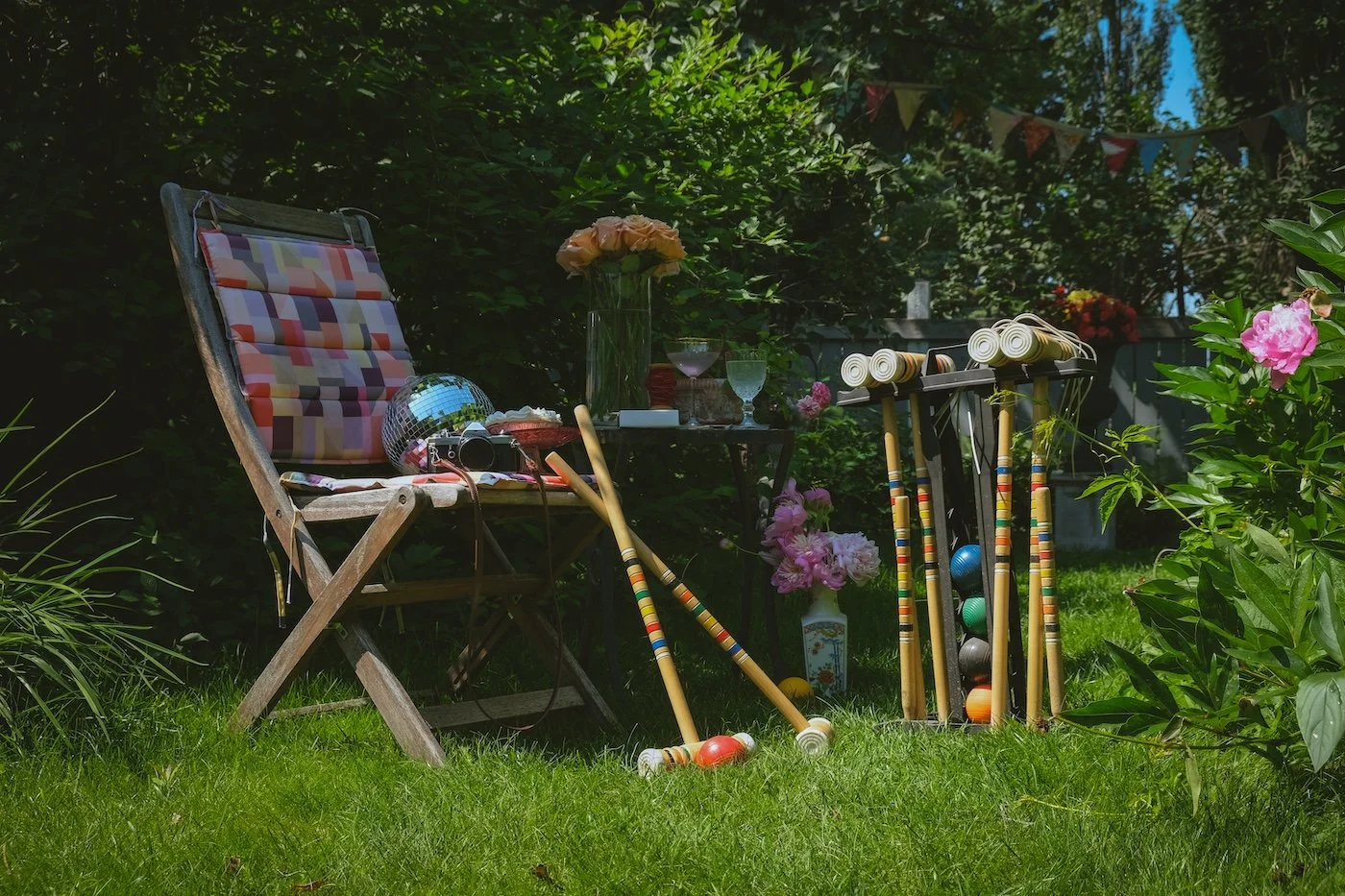
Follow the disco ball reflections and let them dance with the lights in your own skull. Keep dancing with whatever arrives on the dance floor, keep moving, keep using your own words from your own well-lit skull.
Hey, friends, let’s dance to the disco ball lights in our own skulls.
This year I plan on thinking a lot more about what excellence is and why we should insist upon it. Why we should strive for it ourselves (while sometimes considering the opposite) and model it for others, and ask for it in all the spaces that we inhabit. I think of what adrienne marie brown says a lot in her emergent strategies about woe, a term she borrows from Drake, which stands for working on excellence.
I’m still thinking about my friend Lisa Martin’s book on teaching creative writing. We’ve talked about what rigor looks like over drinks but I’m glad to have her words on it in text form, too. (p. 136 of her book is worth a long and luxurious mull over if you teach creative writing or are learning). I returned to her writing on rigor just now and the misread (by me) quotation by Peter Vandenbert on emergent discourse about creative writing, which he defines as an “interplay of lore and scholarship.” The last time I read this it had stuck in my head as “love and scholarship.” Which maybe also works. One of the really great questions in the book is this: “What’s wrong with a question as a place we land, instead of only as a place that we begin?”
Hey, friends, how can we ask rigorous questions with love?
A favourite quotation from adrienne marie brown’s book is this:
“How we are at the small scale is how we are at the large scale. The patterns of the universe repeat at scale.”
This is something that I saw echoed in a book I recently read titled Unreasonable Hospitality. And I always think it’s something of a sign when I hear or read something in one book or context and then hear it in another.
As an aside, maybe it’s an aside, there’s something that I find humiliating about my current situation and that I get to experience 3 to 4 times a week and which I’ve been dwelling on, trying to dispel. It doesn’t really matter what, as it sounds inconsequential really when I say it out loud. But then I recently came across how Christopher Plummer found the fact that his singing voice was dubbed by Bill Lee into The Sound of Music, in spite of the fact that he had hoped and practiced and trained for it, deeply humiliating. And this humiliation seemed to follow him around for most of his career. (This is what he sounds like himself — so emotional and real). It took him a long time to like the movie, though he did, eventually. But for ages, to him, it was always the Sound of Mucus. Moral of the story, it’s hard to love something no matter how great it is, when you feel humiliated.
The important thing, and my takeaway, is to keep your eyes and ears open to whatever divine messages you might be receiving in the form of synchronicities. This is something that I’ve been reminded of reading Kristjana Gunnar’s new and wonderfully deep book The Silence of Falling Snow. In it she says, “It seems to be a commonly held thought that synchronicities are meaningful.”
I have an old copy of Paul Auster’s The Art of Hunger, which contains his The Red Notebook, a wonderful sequence of coincidences. And in an interview before that he relates a note that Wim Wenders had written to a friend of his, “It’s no accident that you’re meeting Paul Auster today. There is no such thing as chance.” And Auster says, “It seems that things like this are happening to me all the time.”
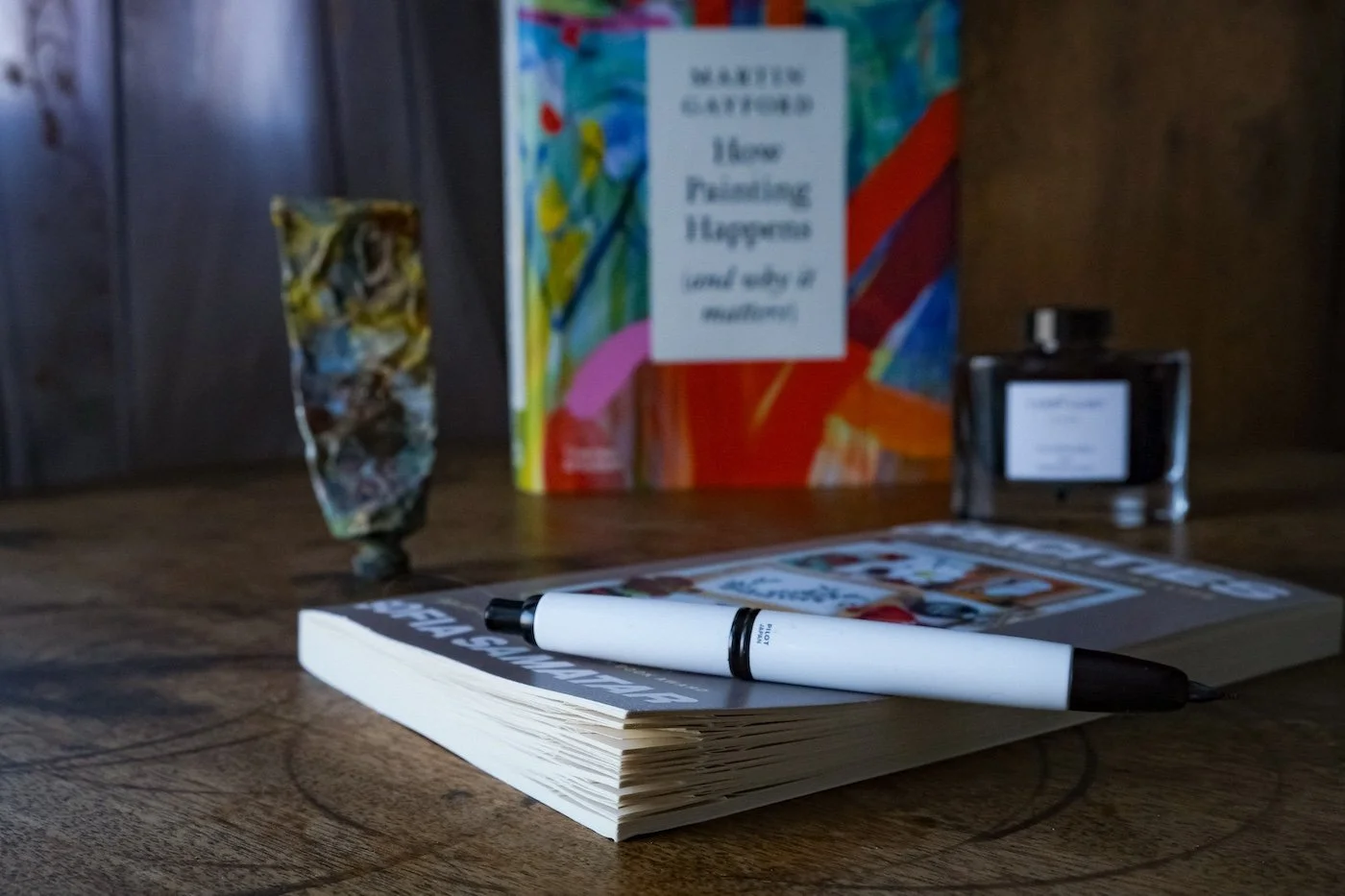
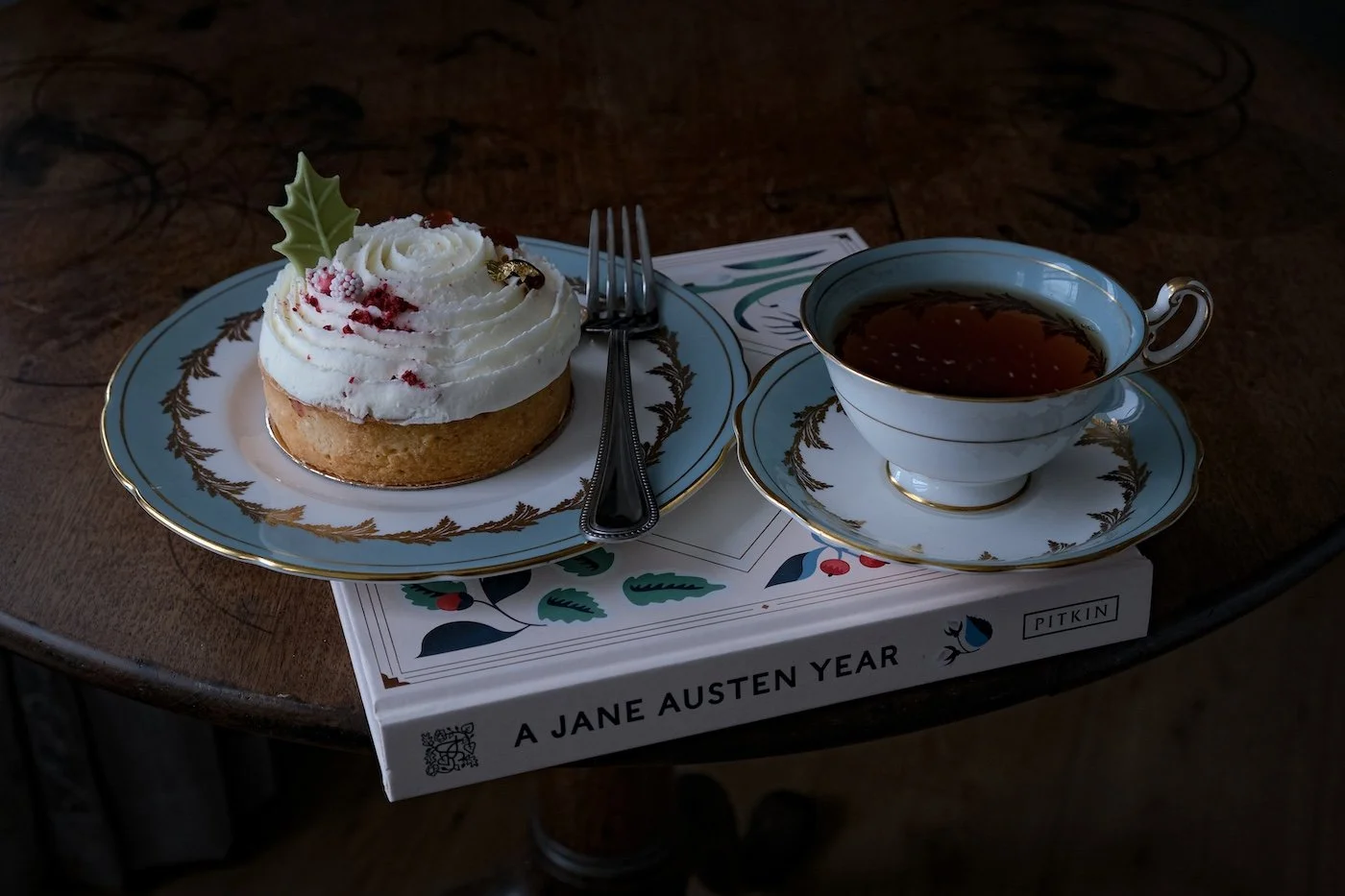
I’d been immersing myself in Jane Austen for my post on the 250th anniversary of her birthday, when I began stacking up books on writing, the creative life, in anticipation of writing this post. I’d picked up a library hold that I’d frankly forgotten about placing for a book titled Opacities by Sofia Samatar. I had wanted to look into it because of our shared love of Clarice Lispector. But the first page that opened for me had this:
““Let us not desert one another, “ Jane urged that anonymous group, her fellow novelists, “We are an injured body.””
Hey, friends, courage, let’s dance with our injured bodies to the disco ball lights in our skulls, and let us not desert one another.

The stack of books I will be reading in the New Year. It’s not an accident right now that writers feel the need to explain what creativity really is. (And guess what it’s not AI).
A poet whose work I love is Ronna Bloom. (Speaking of bloom scrolling!). Her new book In a Riptide is receiving fab reviews, and I’m here for that. I am a huge lover also of short poems, and even one line poems. Here is hers from the book:
Sisyphus Gives Up
Carry your own stone.
I love that poem because it takes some imagining to picture what happens once he gives up. And if we all stopped being Sisyphus and gave up, who would be carrying the stone? Anyway, it takes you places off the page. It’s a refusal, the tone of the poem. The title is a shrug upward, maybe, but the poem puts the stone down, with that rhyme of own and stone.
Another short poem I’ve been thinking of a lot lately is Wendell Berry’s snow poem. That one has been with me a long time.
Like Snow
Suppose we did our work
like the snow, quietly, quietly,
leaving nothing out.
Because really what I can’t stop thinking about is the question, how do we want to be Alive?
You’re familiar with the quotation I often air out here by Elizabeth Smart:
“Isn’t there some statement you’d like to make? Anything noted while alive? Anything felt, seen, heard, done? You are here. You’re having your turn. Isn’t there something you know and nobody else does?”
In Oliver Burkeman’s Meditations for Mortals, he quotes Joanna Macy:
“Action isn’t a burden to be hoisted up and lugged around on our shoulders. It is something we are. The work we have to do can be seen as a kind of coming alive.”
Hey, friends, quiet courage, your work is something you know and nobody else does; it is a kind of coming alive. Your work is not a stone but the snow, falling, quietly, quietly and you must leave nothing out.
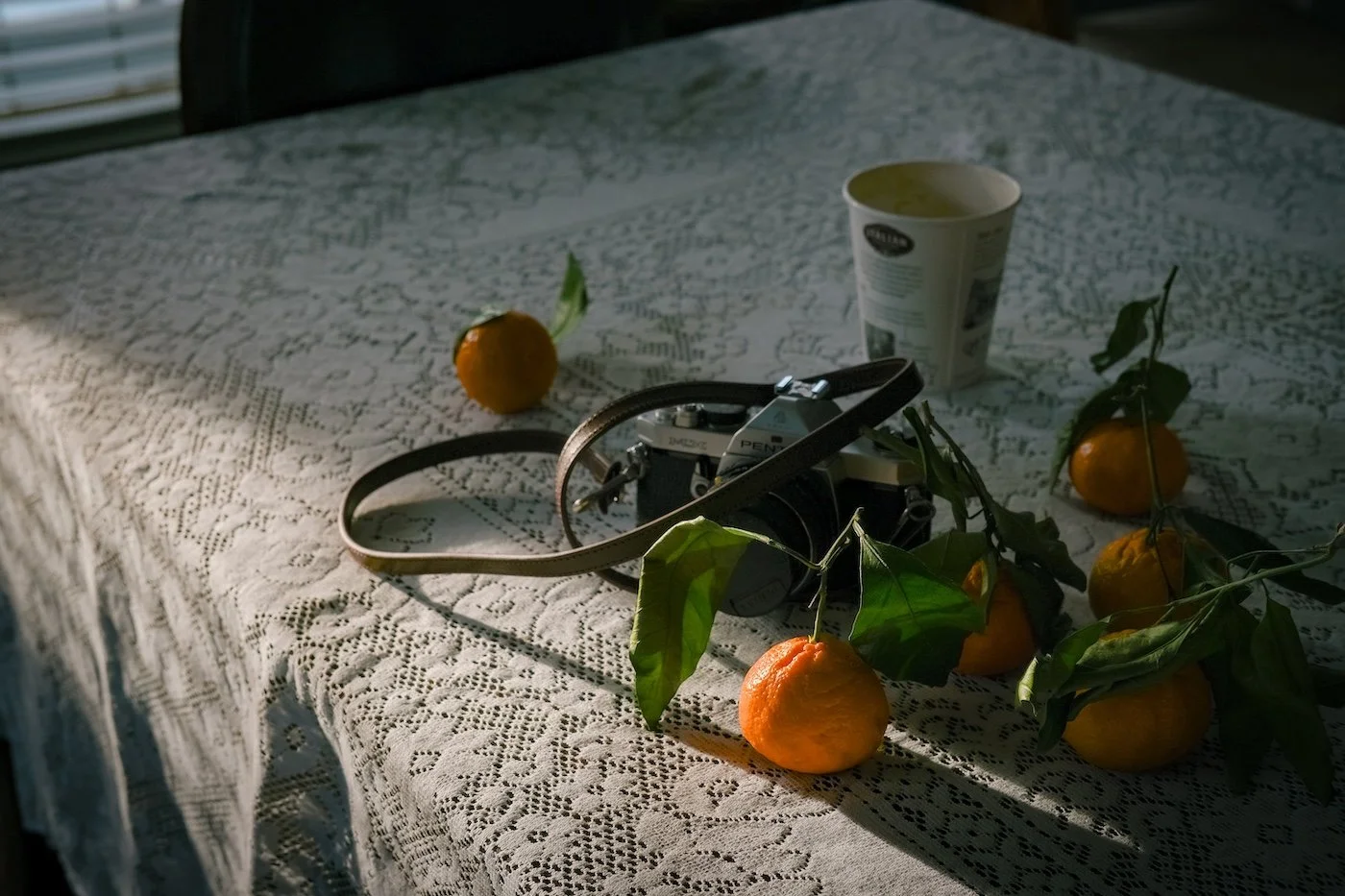
Your work is hope. From Wendell Berry’s essays, It All turns on Affection:
“‘The light within,’ I think, means affection, affection as motive and guide. Knowledge without affection leads us astray. Affection leads, by way of good work, to authentic hope.”
I’ve been dipping into my stack of books that I’ve set aside for my end of the year / first of the NY reads. In How Painting Happens (and why it matters) by Martin Gayford, he quotes Anish Kapoor on Barnett Newman: “What Newman is saying, I think, is that his painting is about the human being in relation to the sublime.”
In his conversation with Euan Uglow, he talks about how Uglow had a very precise system and was obsessed with measurements, proportions. He had a “highly idiosyncratic way of working.” But, he was also “open to, and interested in, many others.” Gayford poses that Uglow might agree with Frank Auerbach who said, “I like all sorts of art, but I don’t like art for which people don’t put themselves out.” He talks about looking at one’s own work through time. When you first make something “they’re too much like bits of wounds in your flesh. Later you can look at them as separate.” Gayford says, “…you start wondering if you’re still able to be that good.” and Uglow responds, “Oh, I’ve got to be optimistic. I’ve got to paint better pictures!…They’ve got to sing better. Each bit of colour has got to ring clearly.”
Hey, friends, the affection you have for your work is your guide. Your work is in relation to the sublime. You’ve got to keep singing better and better. You’ve got to strive, put yourself out.
Thanks for reading my annual new year’s day post and for being here. It means a lot to connect!
This September 2026 will mark the 10 year anniversary of this blog though many of you have been with me for longer via previous blog incarnations. I’ve mulled over moving to Substack, but because I’ve put a lot of love into the posts here, I would prefer not to, you know? And also there is the fatigue of dropping off one platform or another because of one thing or another. Who knows what the future holds but also, who has the energy for all that. So, I’m happy if this stays “my thing.” That said, I feel like I’ll give it to the end of the year to boost up my supporters list via Ko-fi. One starts to feel foolish when one regularly reads about the hundreds of paid supporters people have on Substack. (I currently have 27 wonderful supporters! Thank you to them!).
If one is to believe one’s analytics, my visits this year went up by 200 percent. I currently make approximately 68 dollars per month in subscriptions. All this to say, if you feel like you get 3 dollars per month worth of entertainment out of these posts, could you please consider hitting the tip jar button? :) I’m not sure so far exactly what my goal per month should be for me to continue but I’ll keep you posted.
Thanks for everything and I wish you courage, hope, the conditions to make the sublime and transcendence possible, and work you can do with affection,
Shawna
(a real human who writes every word here herself, and takes every photo herself).