The Entire Universe
— It’s perhaps an evergreen statement these days — I know the news of the world is harrowing today.
— Because the news of the world is harrowing and because the world is full of sorrows, we hold a place here for joy, for when you can get to it, for when it is needed. We lay down some hope and some beauty when we can. Sorrow is not the whole story.
— My favourite podcast is back, On Being. An excerpt from the conversation “This world is full of everything good, everything beautiful,” with Joy Harjo and Tracy K. Smith, poets:
“I just want to say it’s so heart-lifting and opening, and it affirms the hope that I insist on holding to be with the two of you. And I, you know, I’m going to name what we all know which is that the story that we are piecing together up here of what it means to be alive now is not the official story; it’s not in any media platform that any of us can think of today as the story of our time.”
— What we are after is a record of the fullness of existence, as Rilke might say.
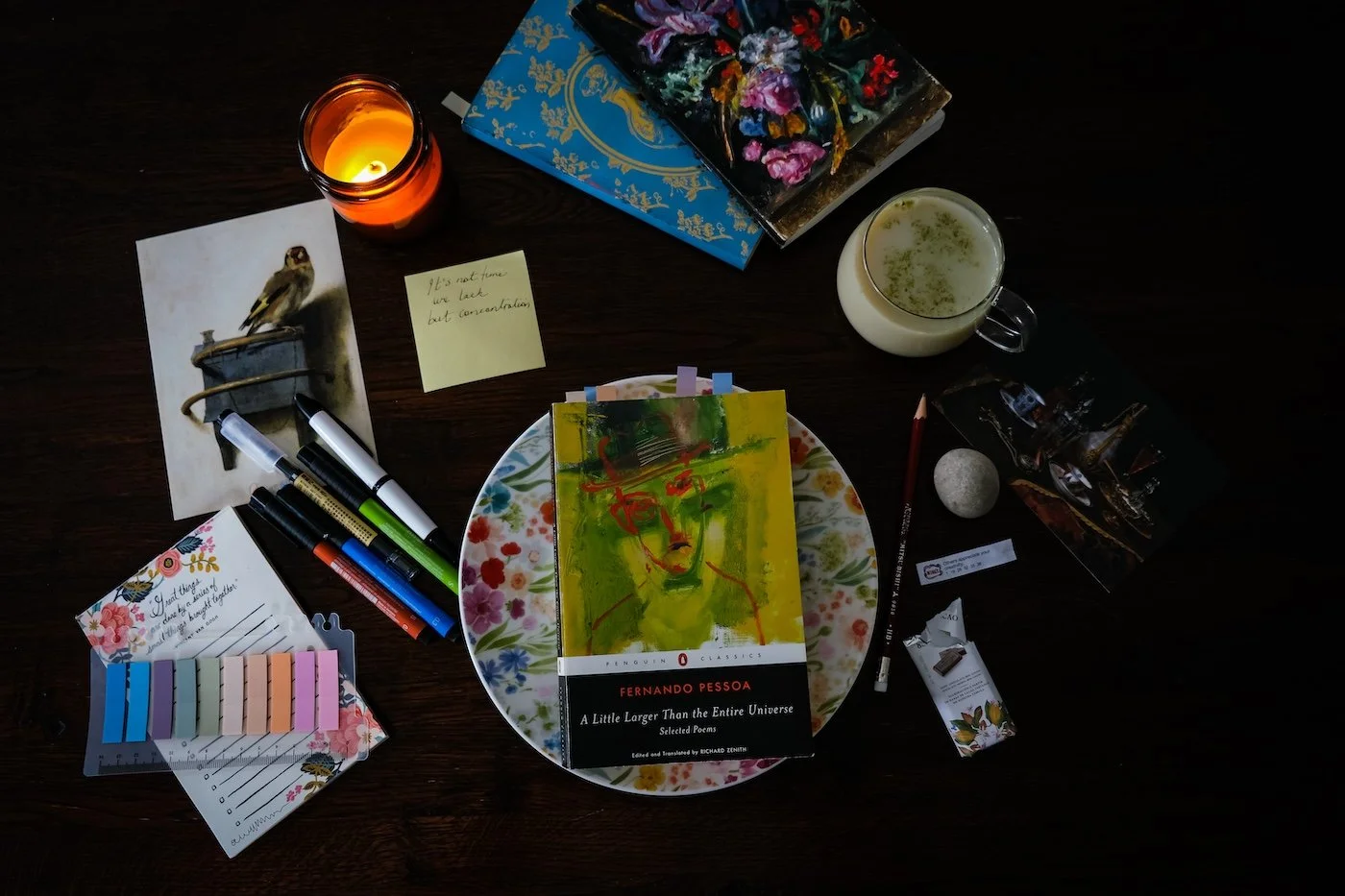
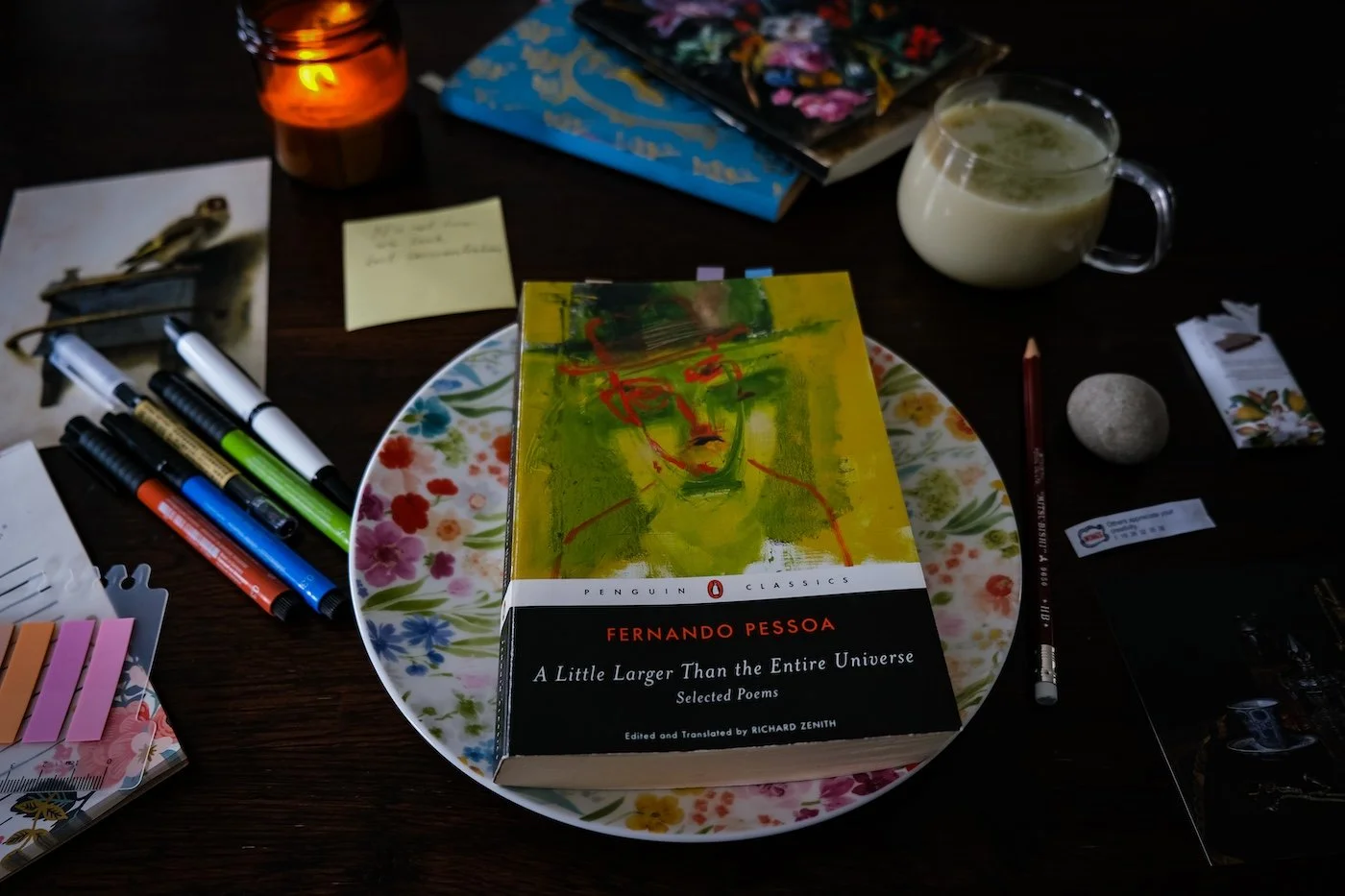
— I’ve been reading Fernando Pessoa’s poems, enjoying all his pseudonyms. So many of his poems contain lines that will get in your head and stay. “The astonishing reality of things / Is my discovery every day. / Each thing is what it is, / And it’s hard to explain to someone how happy this makes me, / And how much this suffices me.” He says, “All it takes to be complete is to exist.”
— An oft quoted poem by Pessoa:
To be great, be whole: don’t exaggerate
Or leave out any part of you.
Be complete in each thing. Put all you are
Into the least of your acts.
So too in each lake, with its lofty life,
The whole moon shines.
— His book A little Larger than the Entire Universe seems to know things about the universe all the way into the future.
— I don’t know how to talk anyone into reading more. If you’re here, no doubt you’ve already been won over to the grand side of reading. You don’t need me for that. Last week I started taking books off my shelf that I haven’t for a while. One of them was Three Steps on the Ladder of Writing by Hélène Cixous. I remember how it made me feel when I first read it (when it came out)! The top of my head was a-flower. The writing was a revelation, the sentences, the thoughts, the technique, the form.
— She says, “What is magnificent about books is that they can wait for us.” She talks about certain sublime readers who “raise reading to the height of poetry, making it an equivalent art.”
— I think there’s still a lot of ways to talk about reading, to think about reading, selecting books, writing books that we’ve only just barely scratched the surface of. The magic of words. Cixous talks about reading Montaigne. The light of the book. The book which “comes through the head.” There is a kind of “true reading” which “establishes another universe of light and dark to that of the outside world, and which is obviously the prolongation of the universe of writing.”
— Reading, finding the books that change our lives, can be an emergency. She talks about that popular quotation by Kafka, “ A book must be the axe for the frozen sea inside us.” These axe-books are rare though. “Because those who write the books that hurt us also suffer, also undergo a sort of suicide, also get lost in forests — and this is frightening.”
— Does every book we read need to be an axe-book? No, but some should be. A fair few.
— As we are now unfathomably (though so fathomably) living once again in the time of banned books, I’ve been thinking in tandem about intellectual freedom and about the magic words that we carry with us through our whole lives, because of books that might now be denied us. There is a passage Cixous quotes from Marina Tsvetaeva which has stayed with me:
“There are magical words, magical apart from their meanings….physically magical, with a magic inherent in the sound itself, words that before they deliver a message already have a meaning…”
— Tsvetaeva says that the magic word through her life has been, “The Pathfinder.” And it is “that unknown thing that is, at the same time, the most known thing.” Cixous says, “Everyone has their magic words. The moment you find your magic word — it may be one word or several — then you have the key, you can start writing.”
— The older you get perhaps the more magic words from books do you accumulate. Or maybe it’s that you recognize them. Remember them. For me, one of the magical phrases has been, the Red Pony. (From Steinbeck). I read it when I was very young, thinking it was a children’s book, like Misty of Chincoteague or The Black Stallion. I read the book well before my own red pony died unexpectedly of a rare thing, later when I was in my teens — and it seemed to portend, retroactively. It was time travel and future telling. It was an axe. But it helped me make sense of the world and still lives in me. It was when I first discovered not all stories have happy endings. It wrecked me. But it also helped in so many ways. I think often about the red pony, mine, his.
— I could go on about the books I read as a child. They made me. And I found them, they compelled me, drew me to them, all on their own. Which should be the way. My grade three report card says that I read at a university level. And so I read things like Flowers for Algernon and the Diary of Anne Frank when I was quite young. I was drawn to the saddest books but they helped make sense of the other books, of life, you know?
— What magic words, magic books, have you embedded within?